Why Am I Tired All Day Even Though I Sleep Fine?
A Sleep Doctor’s Guide for Patients in ND, SD, MN, and IA
By Dr. Arveity Setty MD, TeleSleepClinic.com — Virtual Sleep Medicine Across the Upper Midwest
Feeling tired throughout the day despite “sleeping well” is one of the most common and most frustrating problems I see in my sleep medicine practice. Patients often say:
“I get 6–7 hours of sleep. Isn’t that enough?”
“My primary doctor checked everything and it’s all normal, but I’m still exhausted.”
“My sleep study was normal—so why am I so tired?”
If you live in North Dakota, South Dakota, Minnesota, or Iowa, this might sound familiar. Daytime tiredness is incredibly common, but it’s not normal — and it’s almost always treatable once the right diagnosis is made.
As a sleep specialist doing virtual evaluations through TelesleepClinic.com, I diagnose and treat these issues every day. What many people don’t realize is that feeling tired can happen even if you think you’re sleeping well. Sleep disorders can hide in subtle ways, and even a “normal” sleep study doesn’t always tell the full story.
Let’s explore why this happens — and what you can do about it.
You Can Sleep All Night and Still Wake Up Exhausted — Here’s Why
Most patients assume sleep = hours.
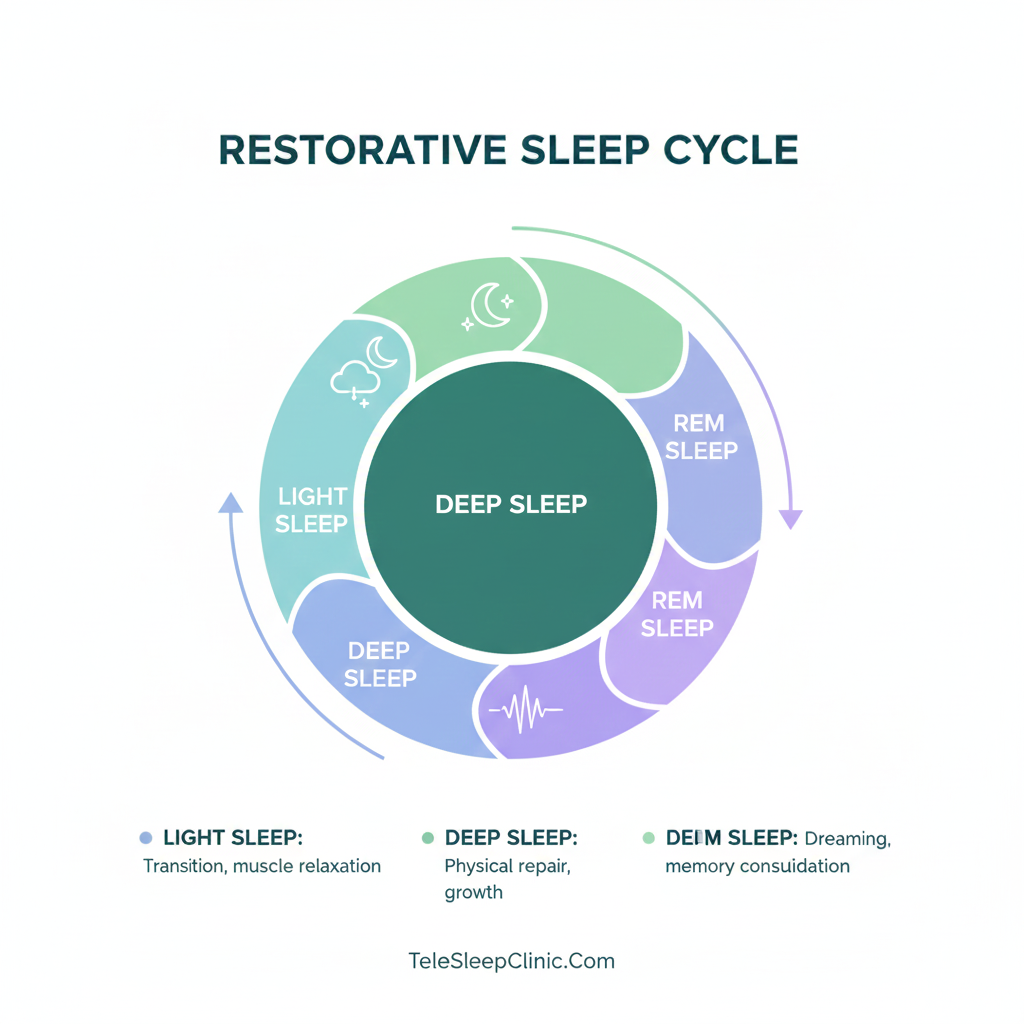
But restorative sleep is about:
- Sleep continuity
- Sleep quality
- Sleep stages
- Breathing quality
- Circadian regulation
- Underlying medical and mental-health factors
Here are the most common causes I diagnose in patients who sleep “fine” but feel tired every day:
✔️ Mild Obstructive Sleep Apnea. Click here to learn more on sleep apnea.
✔️ Fragmented sleep or subtle awakenings
✔️ Circadian rhythm disorders
✔️ Poor sleep efficiency and inadequate sleep hygiene.
✔️ Depression or anxiety
✔️ Medication effects
✔️ Restless Legs Syndrome
✔️ UARS (Upper Airway Resistance Syndrome) etc.
The good news? All of these are manageable once identified.
Case Study #1: “Normal Health, Normal Labs… But Still Exhausted”
Not long ago, I evaluated a 17-year-old who had been struggling with chronic fatigue for months. His primary care team had done all the right testing — bloodwork, thyroid, vitamin levels — everything looked normal.
But he was profoundly sleepy during the day.
During our virtual consultation, I suspected something deeper. After targeted sleep testing, we discovered:
➡️ He had narcolepsy.
Narcolepsy does not always look like dramatic sleep attacks. Sometimes it appears as persistent fatigue, difficulty staying awake in class, and unrefreshing sleep — even if the person sleeps 8 or more hours a night.
Once diagnosed properly, he finally received the treatment he needed, and his life changed dramatically.
Case Study #2: When a “Normal” Home Sleep Study Wasn’t the Full Story
Home sleep apnea tests (HSAT) are excellent tools — easy, convenient, and shipped to patients across ND, SD, MN, and IA with nearly no waiting period through our clinic.
But HSAT isn’t perfect either although convenient and quick.
One patient came to me absolutely convinced he had sleep apnea, despite his normal HSAT. His symptoms didn’t match the results, so we proceeded with an in-lab sleep study.
➡️ It revealed severe sleep apnea.
If we had relied only on the home test, his diagnosis would have been missed, and his health would have continued to suffer.
On the other hand, another patient with a normal HSAT turned out to have shift work sleep disorder — a circadian problem common in rural and agricultural communities.
This is why expert interpretation matters.
What Most People Get Wrong About Sleep
Many believe that 6–7 hours of sleep is enough or that “going to bed early” guarantees restorative rest.
But restorative sleep means:
- You wake up in a good mood
- You feel mentally clear
- You don’t need naps or caffeine to function
- You stay awake during normal daytime activities
If you regularly feel the urge to fall asleep during the day — even if you sleep a “normal” amount — your sleep is not restorative.
What Makes TelesleepClinic.com Different
In the rural regions of ND, SD, MN, and IA, many patients face:
- Long wait times
- Long drives to sleep clinics
- Limited access to specialists
At TelesleepClinic.com, we’ve removed these barriers:
✔️ Virtual visits available almost immediately
✔️ Home sleep studies shipped directly to your home
✔️ Expert interpretation so subtle or hidden disorders aren’t missed
✔️ Full access to in-lab referrals when needed
✔️ Modern, comprehensive sleep evaluations without leaving home
You get the same quality of care you’d receive in person — just without the delay.
How We Evaluate Unexplained Daytime Fatigue
When a patient tells me, “I sleep fine, but I’m tired all day,” I use a structured, comprehensive approach that includes:
🔹 Home Sleep Apnea Testing
🔹 In-lab sleep studies when symptoms and tests don’t match
🔹 Epworth Sleepiness Scale
🔹 Circadian rhythm assessment
🔹 Sleep diaries and wake patterns
🔹 Medication review
🔹 Anxiety, depression, or stress screening
🔹 Iron studies for Restless Legs Syndrome
If needed, we explore advanced testing for narcolepsy or hypersomnia.
The point is:
We never stop at “everything looks normal.”
We find the root cause.
You Don’t Have to Live Tired
Here’s the truth:
Daytime fatigue is a symptom, not a personality trait.
Something is causing it.
And it’s almost always treatable.
If you’re tired all day despite sleeping what you believe is “enough,” it may be:
- A hidden sleep disorder
- A circadian rhythm issue
- A breathing disturbance your HSAT didn’t catch
- A treatable neurological disorder like narcolepsy
- A fragmented sleep pattern you aren’t aware of
And the solution starts with a proper evaluation.
Take the First Step Toward Feeling Better
You can schedule a virtual sleep consult or order a home sleep study directly from anywhere in:
- North Dakota
- South Dakota
- Minnesota
- Iowa
👉 Visit TelesleepClinic.com to schedule your appointment.
You don’t have to live tired.
You don’t have to guess.
Help is available — and it starts today.